
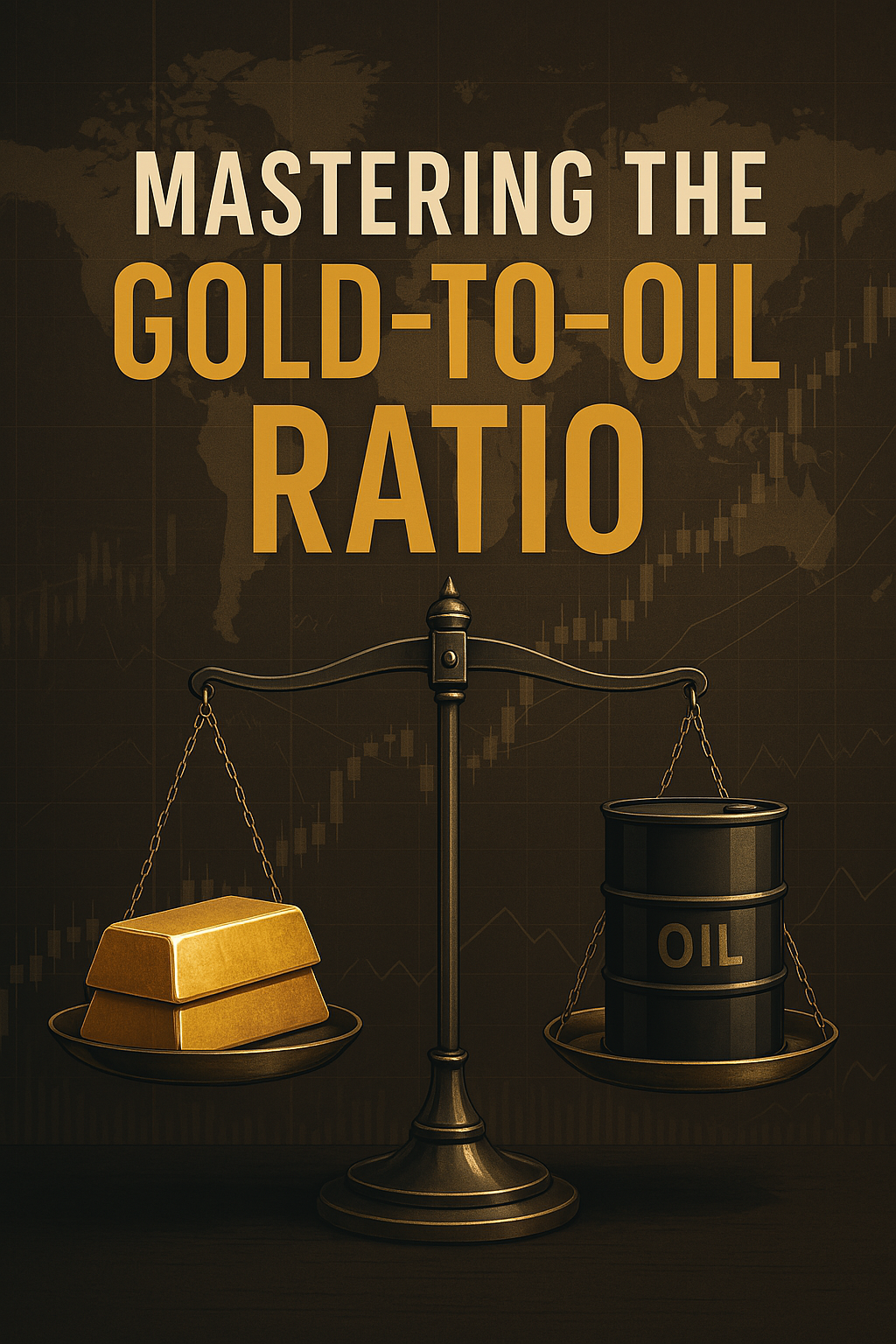
One tool that quietly reveals major shifts in the economy and trading opportunities — often before the crowd catches on — is the Gold-to-Oil ratio.
If you’ve ever wondered what the true pulse of the global economy feels like beneath all the headlines, you’ll want this indicator in your arsenal.
Let’s break it down.
What Is the Gold-to-Oil Ratio?
The gold-to-oil ratio measures how many barrels of crude oil you can buy with one troy ounce of gold.
Formula:
Gold price (per ounce) ÷ Crude oil price (per barrel)
Example:
If gold trades at $1,800/oz and oil trades at $90/bbl, the ratio is 20. Meaning:
→ One ounce of gold buys 20 barrels of oil.
Sounds simple, right?
But beneath that simplicity lies a powerful story about inflation, risk appetite, economic health, and future market trends.
How to Read It
- High ratio → Gold is expensive compared to oil → Investors are nervous → Economy might be under stress.
- Low ratio → Oil is expensive compared to gold → High demand for oil → Economy may be booming.
Think of it this way:
When an ounce of gold buys a ton of oil, oil is likely undervalued — or gold is very overvalued.
When an ounce buys very little oil, oil might be overpriced — and growth/inflation might be heating up.
Historical Norm:
The gold-to-oil ratio has typically lived between 10 and 30 over the decades, with a long-term average around 15.9.
Anything outside that range? You’re looking at rare, volatile conditions — and potential trading opportunities.
Why Serious Investors Watch This Ratio
1. A Real-Time Economic Health Check
A rising ratio often signals fear — investors rushing to gold, while oil demand weakens.
2. Inflation & Dollar Clues
Oil spikes = inflation worries → boosts gold (an inflation hedge).
A strong U.S. dollar, though, can drag down both commodities.
3. Supply vs Demand Insight
Oil is tied to industrial supply and demand. Gold is driven more by financial flows.
When the real economy stumbles but financial markets panic, the ratio explodes.
Bottom line:
The gold-to-oil ratio is like a heartbeat monitor for the global economy.
Major Historical Case Studies
Let’s see it in action:
2008 Global Financial Crisis
- Pre-crisis: Oil was sky-high ($145/bbl), gold lagging ($1,000/oz) → Ratio collapsed to 6.4 (extremely low).
- Crisis hits: Oil demand collapsed; oil prices crashed below $40, while gold rallied as a safe-haven.
- Result: Ratio tripled almost overnight — warning of severe economic distress.
Lesson:
A ratio this low was a flashing red light that oil was overpriced and a crisis was looming.
2014–2016 Oil Price Collapse
- OPEC flooded the market → Oil crashed from $100 to $30.
- Gold stayed relatively flat → Ratio soared above 38.
Lesson:
When the ratio went above 30, oil was dirt cheap relative to gold — setting up huge buying opportunities in oil and energy assets.
2020 COVID-19 Crash

- Oil demand vaporized during lockdowns.
- Gold surged as panic set in.
- Ratio hit an insane 131:1 — the highest in history.
Lesson:
When the ratio hits extreme highs, fear has likely overshot. Oil’s rebound after 2020 was sharp and profitable for those who kept calm.
2024–2025: Current Market Dynamics
- Gold hit new records above $2,500/oz (recession and inflation fears).
- Oil softened as supply soared (shale boom + China slowdown).
- The ratio climbed to around 39:1 — way above the five-year average.
Takeaway for 2025:
Today’s elevated ratio suggests gold is richly priced relative to oil. If history is a guide, oil might be setting up for another comeback.
How Traders and Investors Use the Gold-to-Oil Ratio
Here’s how you can put it to work:
1. Contrarian Signal
- High Ratio: Oil undervalued → Look at energy plays, oil futures, energy ETFs.
- Low Ratio: Gold undervalued → Look at gold, gold miners.
The key?
The ratio mean-reverts over time. Extremes tend not to last.
2. Pair It with Fundamentals
Never trade the ratio blindly.
Use it as a signal to investigate further: Are oil supplies rising? Is inflation spiking? Are investors panicking irrationally?
Smart money waits for confirmation before acting.
3. Portfolio Management and Hedging
Some investors tilt portfolios based on the ratio: more oil when ratios are high, more gold when ratios are low.
Others trade the spread directly — going long one commodity and short the other.
Bonus:
Even if you don’t trade commodities, the ratio can tell you when stocks or credit markets might be stressed.
Final Thoughts: Why the Gold-to-Oil Ratio Matters Now
The gold-to-oil ratio gives traders a way to read the market’s mood without relying on noisy headlines.
Today, in 2025, it’s screaming that gold is historically expensive relative to oil.
It’s the kind of imbalance that doesn’t last forever.
History shows that those who listened to this signal — in 2008, 2016, and 2020 — were rewarded.
Will it happen again?
Only time will tell — but the gold-to-oil ratio is whispering a clue to those who know how to listen.
I’ll be watching. Will you?
For more indebt analysis, become a Samurai Class paid member and hit the link: https://takezotrading.com/the-gold-to-oil-ratio-a-historical-and-practical-guide/
Become a member for deeper analysis and data
Takezo Trading