
Oil, gold, and the slow-burn pressure on the carry trade
By Takezo Trading | 25/04/26 | Reading time: ~7 minutes
This Week’s Bottom Line
If you only have two minutes, here’s what matters:
- The macro driver this week is energy and geopolitics. With the U.S.–Iran conflict ongoing and the Strait of Hormuz effectively closed, oil supply remains constrained. That feeds a slow-burn inflation story that every major central bank now has to weigh.
- Gold has been consolidating for several weeks after a strong run. That’s not a bearish signal — it’s the market catching its breath at elevated levels.
- Central banks are all expected to hold this week. BOJ, BOC, FOMC, BOE, and ECB all on deck. Expectations are for no change across the board, which makes the tone of each statement more important than the rate decision itself.
- The carry trade is the trade to watch. A sustained oil shock could force the BOJ’s hand on policy — and a meaningful BOJ shift would unwind the most crowded trade in global FX.
- VIX sits at $18.71 — elevated but not panicked. Risk assets are holding up despite the geopolitical backdrop, which is its own piece of information.
Regime read: Cautiously risk-on, with a clear inflationary undertone from energy. War is usually inflationary over the medium term — and this one has the supply-side ingredients to be especially so.
The Macro Picture
Energy is the linchpin
The Strait of Hormuz remains closed, and there’s no constructive path visible from the current round of talks. About a fifth of global oil flow normally moves through that chokepoint, so when it closes, the price effects ripple everywhere — fuel costs, transport costs, manufacturing inputs, food prices through the supply chain. The market is repricing all of it in slow motion.
Oil is rising. The Gold–Oil ratio sits at 49.64, which is well above its long-term average. That tells us gold is still expensive relative to oil — but it also means gold has been climbing faster than oil even as oil has rallied. When both safe-haven assets and energy are bid at the same time, you’re looking at a market that’s pricing in stagflation risk, not pure growth optimism.
For more on the Gold-Oil ratio and how I use it, see my deeper write-up here: The Gold-to-Oil Ratio: A Historical and Practical Guide
The Japan problem
Here’s where the threads connect into something tradeable.
Japan imports nearly all of its oil. With the Strait of Hormuz disrupted and energy costs climbing, Japan’s import bill is set to balloon. That feeds directly into domestic inflation and the BOJ has spent the last several years inching, very cautiously, toward policy normalization. Their current policy rate sits at 0.75%, and the JPY 10-year is now at 2.433% historically high for Japan.
If oil-driven inflation forces the BOJ to hike more aggressively than the market expects, the implications are global. The yen carry trade borrowing cheaply in JPY to fund higher-yielding positions elsewhere has been one of the most crowded trades in markets for years. A meaningful BOJ shift is the catalyst that could unwind it. And when crowded trades unwind in FX, the moves are violent.
Market Snapshot
Central Bank Policy Rates
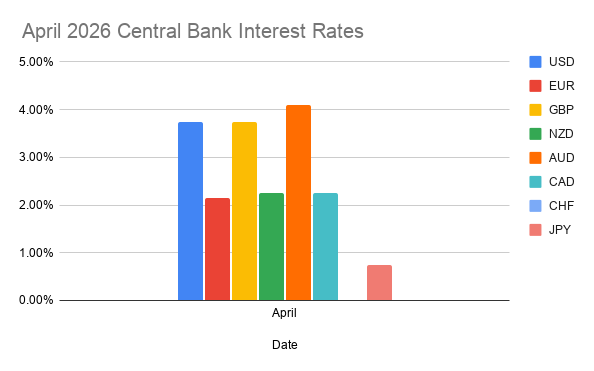
| Currency | Rate |
|---|---|
| AUD | 4.10% |
| GBP | 3.75% |
| USD | 3.75% |
| NZD | 2.25% |
| CAD | 2.25% |
| EUR | 2.15% |
| JPY | 0.75% |
| CHF | 0.00% |
The interest rate differential between AUD/CHF (4.10% vs. 0.00%) and AUD/JPY (4.10% vs. 0.75%) keeps these among the cleanest carry-positive pairs — which lines up with what the gold-anchored confluence analysis flagged earlier this week.
10-Year Sovereign Yields
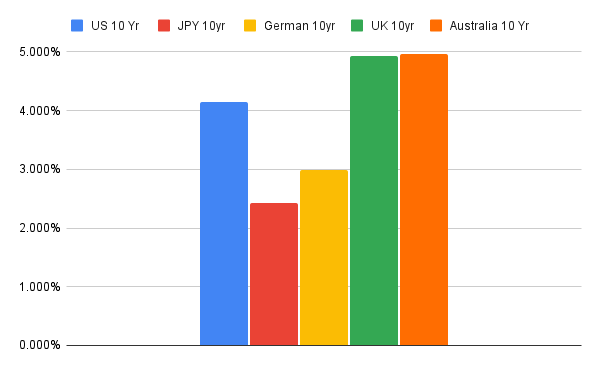
| Country | 10Y Yield |
|---|---|
| Australia | 4.957% |
| United Kingdom | 4.931% |
| United States | 4.306% |
| Germany (EUR) | 2.995% |
| Japan | 2.433% |
AUD and GBP yields are running near 5%, reflecting both the sticky inflation backdrop and the energy story. The EUR–USD yield gap of over 130 basis points helps explain why the Euro has struggled to gain traction despite its mid-pack short-term performance.
Equities vs. Gold
| Index | Ratio |
|---|---|
| Nikkei 225 | 12.68 |
| DAX | 6.01 |
| FTSE 100 | 2.98 |
| CAC 40 | 2.03 |
| S&P 500 | 1.52 |
The Nikkei leads the pack on a gold-relative basis — Japanese equities have just printed a fresh record above 60,000 on a tech-led rally, and that strength is showing up clearly versus gold. European equities also remain firm, with the DAX standing out among the Western indices. The S&P 500 is the laggard of the group — not weak in absolute terms, but consolidating relative to gold’s run.
Volatility & Commodities
- VIX: $18.71 — elevated but not flashing red
- Gold–Oil Ratio: 49.64 — well above historical average
Central Bank Scoreboard — The Week Ahead
Five major central bank events in five days. None of them are expected to move on rates, but each has the capacity to shift tone meaningfully. Here’s what I’m watching:
🇯🇵 BOJ — Monday, April 27th
Current Rate: 0.75% | Expected: Hold
This is the most important meeting of the week, even though a hold is fully priced. The market will be parsing every word for signals on how the BOJ is interpreting imported energy inflation. Any hawkish tilt is a yen-supportive shock and a direct threat to the carry trade. A dovish reaffirmation extends the JPY-weakness regime.
🇨🇦 BOC — Wednesday, April 29th, 9:45 AM
Current Rate: 2.25% | Expected: Hold
Canada sits in an interesting position — high oil prices help the loonie, but the BOC has been on a dovish tilt with growth concerns weighing. The statement language on the energy backdrop matters more than the rate itself.
🇺🇸 FOMC — Wednesday, April 29th, 2:00 PM
Current Rate: 3.75% | Expected: Hold
The Fed is the most important policy voice for global risk assets. With oil running and geopolitical tension elevated, the market wants to know how Powell frames the inflation-vs-growth trade-off. A hawkish hold (acknowledging energy inflation) lifts the dollar; a dovish hold (focused on growth concerns) caps it.
🇬🇧 BOE — Thursday, April 30th, 7:00 AM
Current Rate: 3.75% | Expected: Hold
The UK has both the highest 10-year yield among G10 majors and a sticky inflation problem. The BOE’s read on oil-driven inflation pass-through will guide the next leg of GBP positioning.
🇪🇺 ECB — Thursday, April 30th, 8:15 AM
Current Rate: 2.15% | Expected: Hold
Europe is arguably the most vulnerable to a sustained oil shock — high import dependence, weaker growth backdrop, and a central bank already at relatively low rates. Lagarde’s framing of inflation risks vs. recession risks is the key tell.
FX Playbook
The watchlist this week is built on the gold-anchored confluence analysis published earlier today. The full breakdown is here:
🔗 Currency Pair Trade Recommendations: Gold-Anchored Confluence Analysis
The headline setups:
- Long AUD/JPY — strongest currency vs. weakest, confirmed across all four timeframes. The carry differential and the gold-strength confluence both point the same way. The risk is a BOJ surprise; size accordingly.
- Long AUD/USD — AUD outperforming USD across every timeframe, supported by yield differential.
- Long CHF/JPY — clean safe-haven proxy if geopolitical risk escalates.
- Short EUR/AUD — EUR weakness from oil import dependence + AUD strength from carry and commodities.
For COT-supported context on speculative positioning extremes, see this week’s COT update:
🔗 Commitment of Traders Update – April 25th, 2026
Weekly Playbook
1. Primary macro driver: Energy-driven inflation from the Strait of Hormuz disruption, and how each central bank chooses to talk about it.
2. Best FX expression: Carry-positive, commodity-tilted longs (AUD-led) against funding currencies (JPY, CHF for safe-haven crosses; EUR for oil-exposed crosses).
3. What flips the view: A hawkish BOJ surprise that triggers serious carry-unwind talk, or a sharp de-escalation in the Middle East that brings oil down quickly. Either would force a positioning reset.
4. Key event risk days: Monday (BOJ), Wednesday (BOC + FOMC), Thursday (BOE + ECB). Five events in five days — manage exposure into each.
5. Risk management note: With multiple central bank events stacked into one week and a live geopolitical backdrop, position sizing should be smaller than usual. The market’s ability to gap on a single headline is high. Use defined risk, respect your stops, and don’t chase moves into central bank prints.
Trade safe out there.
— Takezo
This post is for educational and informational purposes only and does not constitute financial advice. Always do your own research and trade according to your own risk tolerance.