
Takezo Trading | Week of 18 July 2026 Gold-Benchmarked Pair Analysis
The Method
Gold is the yardstick. By measuring each of the eight majors against gold over the same window, we get every currency priced in a single common unit. Once that’s done, gold drops out of the comparison entirely and what remains is pure relative strength between the currencies themselves.
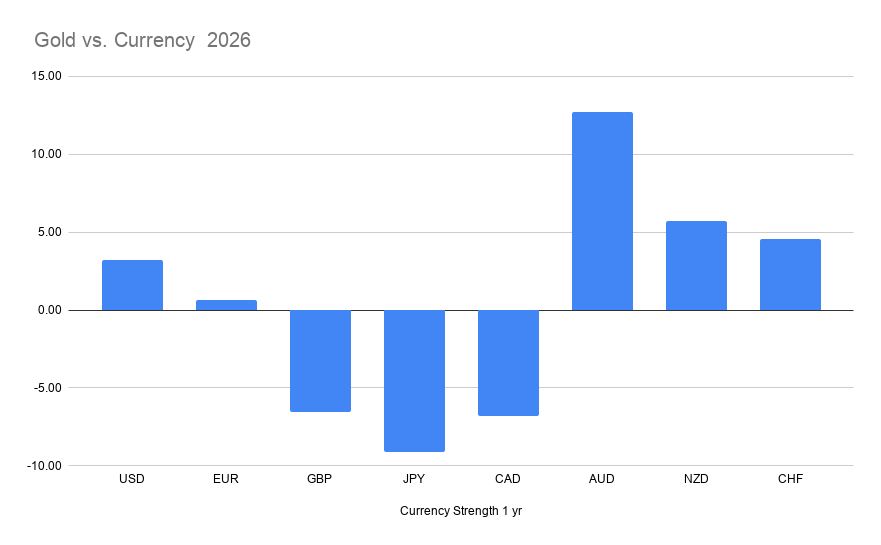
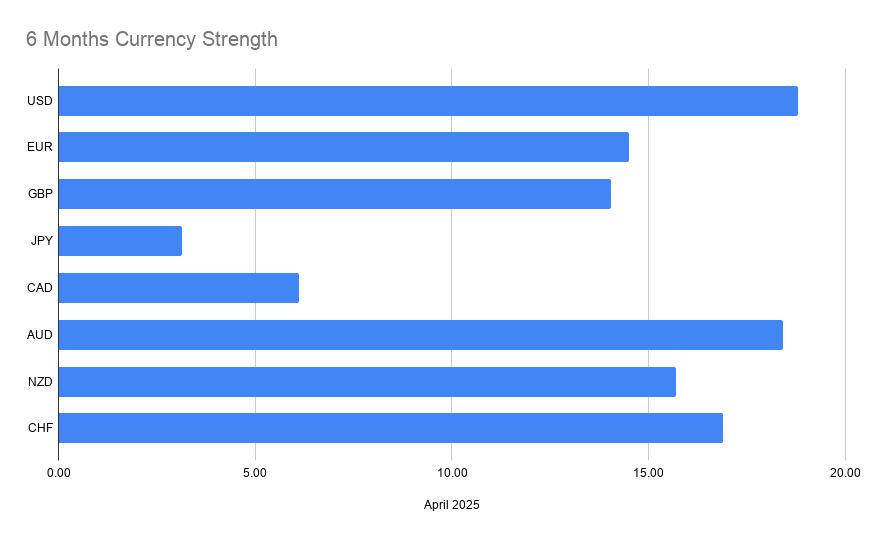
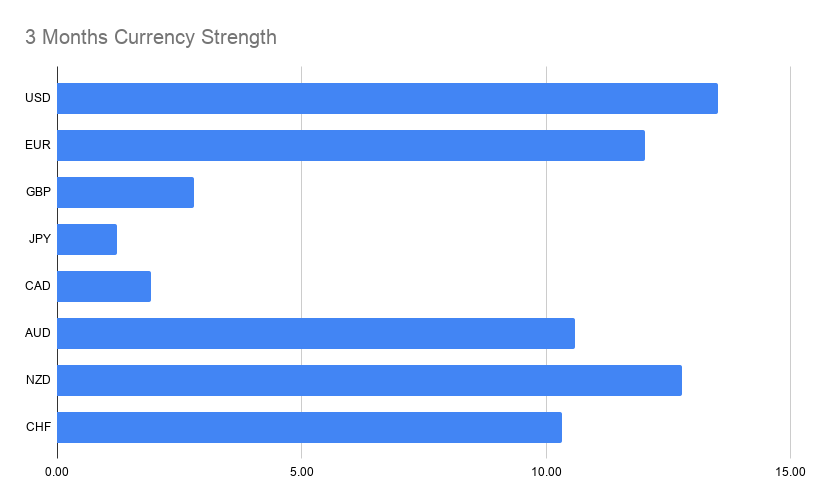
We run that comparison across four timeframes: the 1-Year, the 6-Month, the 3-Month, and the current month. A pair earns a place below only when the same currency comes out stronger across multiple windows. Where a pair points one way on the long charts and the other way on the short ones, there’s no edge, and it gets left out.
No fundamentals, no news, no rate expectations. Only what the strength charts show, quoted in standard FX convention.
This Week’s Picture
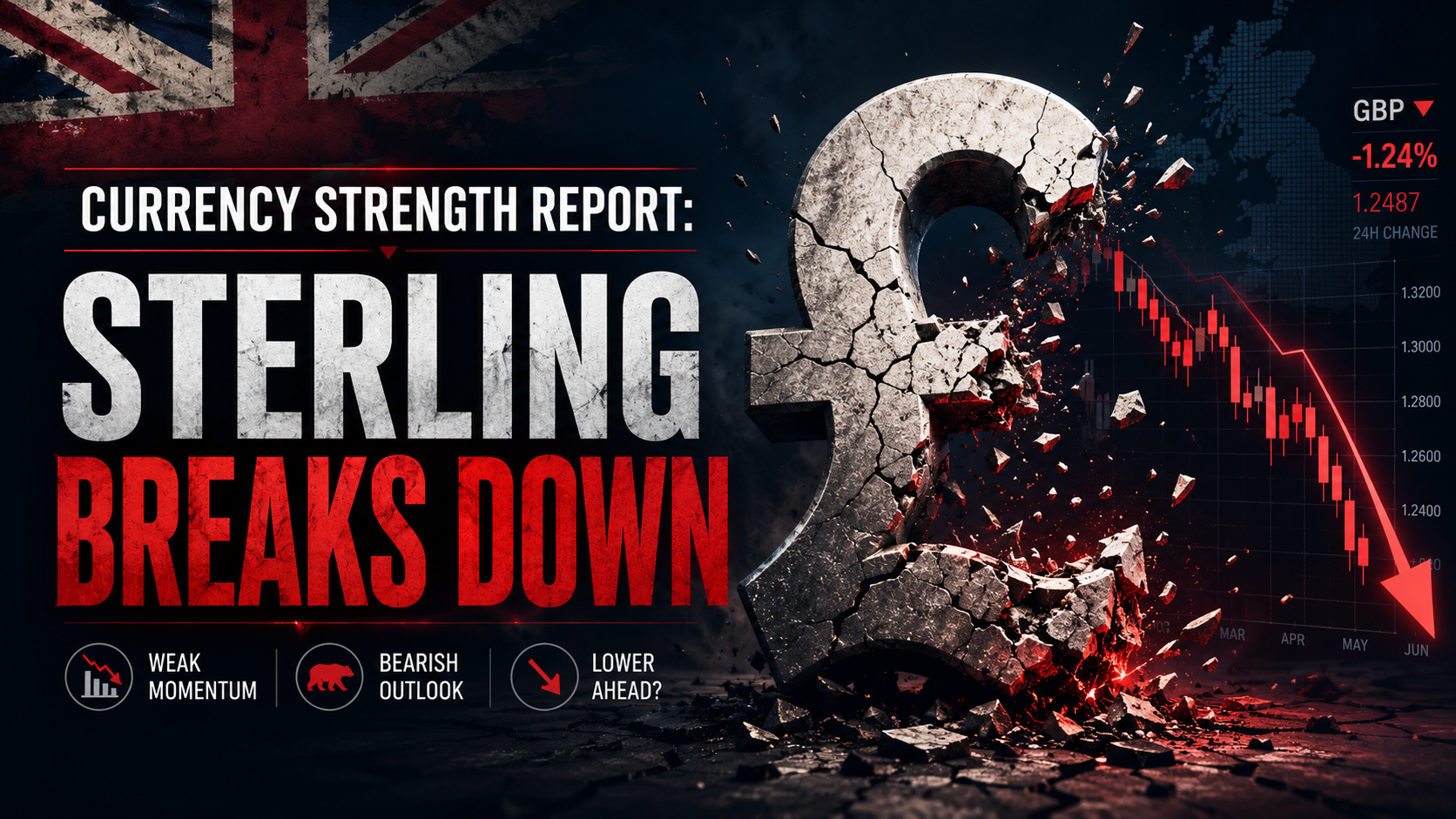
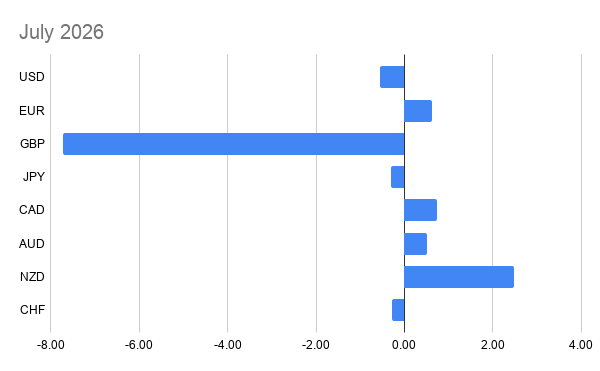
The pound is the story, and it isn’t close. GBP finished July at roughly -7.7 against gold while every other major sat between -0.5 and +2.5. That is not a currency drifting to the back of the field; it is a currency in a different postcode. Sterling is also the second-weakest performer on the 1-Year chart and sixth of eight over three months, so July isn’t an isolated stumble — it’s an acceleration of something already in place.
That gives us the cleanest set of sterling shorts we’ve seen in months. GBP is confirmed weaker than the Aussie, the Kiwi, the dollar and the franc across all four timeframes, with EUR/GBP long joining them.
There is a wrinkle worth understanding. GBP/CAD and GBP/JPY are long, not short — and both appear on the watchlist rather than the confirmed list. The reason is simple: the loonie and the yen are weaker still over the medium and long term, so sterling outranks them on three of four charts. July is the exception, where the pound’s collapse dropped it below even those two. Sterling is weak; CAD and JPY have been weaker for longer.
On the other side of the ledger, the New Zealand dollar and the Aussie are carrying the strong end. The Kiwi topped the July chart outright and sits second over three months and one year. The Aussie leads the 1-Year comfortably and runs second over six months.
One caveat on reading the charts. Outside of sterling, July is tightly compressed — seven of the eight currencies fall within a three-point band. Several of this week’s unconfirmed signals turn on differences of a fraction of a point on that chart. The direction over the longer horizons is clear; it’s the monthly snapshot that’s fine-grained.
High-Conviction Signals
These pairs point the same direction on all four charts.
- GBP/AUD — Short
- GBP/NZD — Short
- GBP/USD — Short
- GBP/CHF — Short
- EUR/GBP — Long
- EUR/NZD — Short
- EUR/JPY — Long
- AUD/CHF — Long
- AUD/JPY — Long
- NZD/CAD — Long
- NZD/JPY — Long
- CAD/JPY — Long
The Watchlist
These pairs align on three of the four charts. They aren’t wrong — they’re unconfirmed, and the dissenting chart is named beside each. Almost all of them fail on July, and most involve either the Canadian dollar or the yen, both of which firmed slightly in the monthly window after long stretches at the bottom. Lower conviction; size accordingly.
- USD/CAD — Long (unconfirmed on July)
- USD/JPY — Long (unconfirmed on July)
- EUR/CAD — Long (unconfirmed on July)
- AUD/CAD — Long (unconfirmed on July)
- GBP/CAD — Long (unconfirmed on July)
- GBP/JPY — Long (unconfirmed on July)
- EUR/USD — Short (unconfirmed on July)
- CAD/CHF — Short (unconfirmed on July)
- NZD/CHF — Long (unconfirmed on 6-Month)
- CHF/JPY — Long (too close to call on July)
See you next week.