A concise summary of what matters most for FX this week: Japan yield pressure, carry-trade fragility, and gold’s message versus broader risk-on signals.
Takezo Trading | 24 Jan 2026 • Estimated reading time: 7 minutes
This Week’s Bottom Line
- Macro driver: Japan’s long-end yields are rising, and that is the key stress point for FX because it threatens the stability of global carry positioning.
- Market regime: Risk-on, but cautious. Equities are not signaling panic, but gold is still acting like a hedge is needed.
- Key risks:
- Japan carry trade risk: JGB yields are climbing; carry can keep working—until rising yields force an unwind (or accelerate one already in progress).
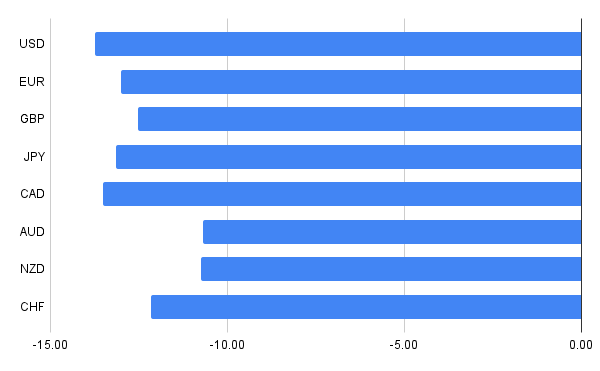
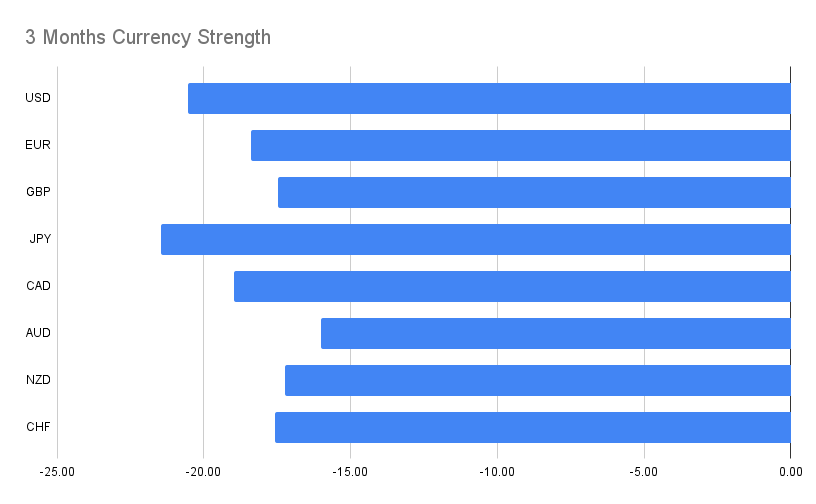
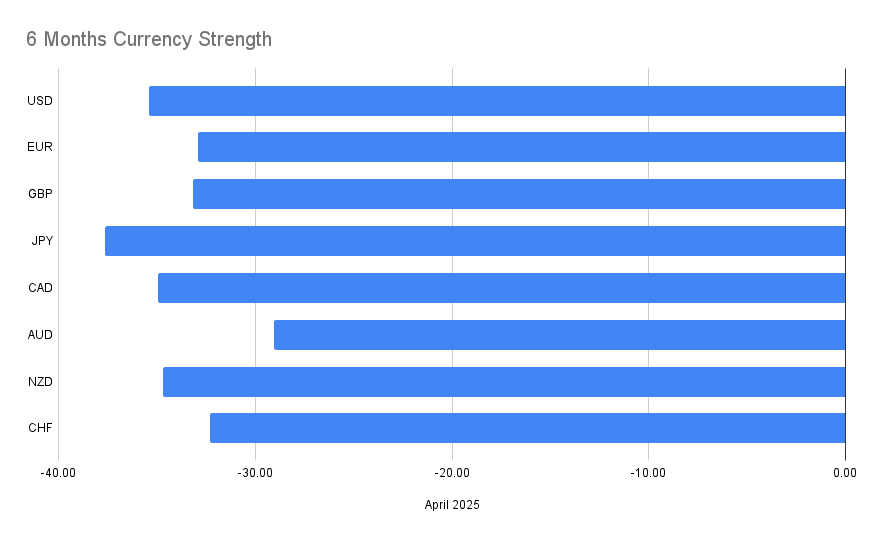
- Gold’s warning: Gold is outperforming fiat currency. That’s a classic “flight-to-safety / debasement hedge” signal, but other indicators don’t fully confirm a broad risk-off regime.
- Structural demand angle: Gold strength also aligns with the longer-term theme of countries gradually reducing USD dependence (e.g., increasing gold reserves while managing Treasury exposure).
Bias Map
Pro-risk / anti-risk: Pro-risk, but with a tight risk leash due to (1) Japanese carry vulnerability, (2) geopolitics (war risk and spillover into Europe), and (3) supply-chain disruption risk tied to Iran escalation.
FX approach this week: Watchlist based on Gold vs Currency (favored because direction is consistent across timeframes).
FX Watchlist — Gold vs Currency Strength (Consistent Across Timeframes)
This is the core directional watchlist for the week. These are the pairs that remain aligned across multiple horizons, which is why they make the best candidates for clean, “macro-consistent” trades.
How to use this section:
This is a watchlist, not a mandate to trade everything. Pick 1–3 expressions that match your risk tolerance and the week’s event risk (see the playbook at the end).
Currency strength
| Pair | Direction (consistent across all 3 timelines) |
| AUDCAD | BUY |
| AUDCHF | BUY |
| AUDJPY | BUY |
| AUDNZD | BUY |
| AUDUSD | BUY |
| CADCHF | SELL |
| EURCAD | BUY |
| EURCHF | SELL |
| EURAUD | SELL |
| EURJPY | BUY |
| EURUSD | BUY |
| GBPAUD | SELL |
| GBPCAD | BUY |
| GBPJPY | BUY |
| GBPUSD | BUY |
| NZDCAD | BUY |
| NZDJPY | BUY |
| NZDUSD | BUY |
| USDCAD | SELL |
| USDCHF | SELL |
Market Snapshot (What happened last week)
Rates
Central Bank Policy Rates (Current)
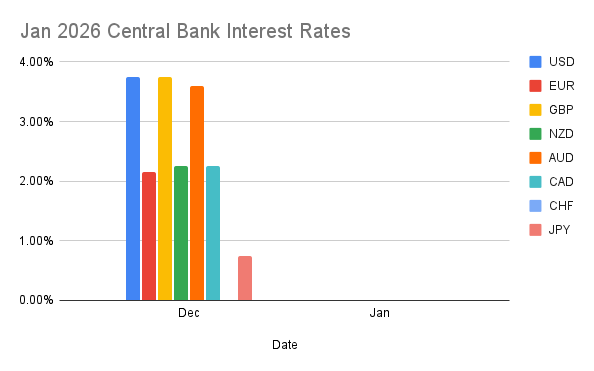
- USD: 3.75%
- EUR: 2.15%
- GBP: 3.75%
- NZD: 2.25%
- AUD: 3.60%
- CAD: 2.25%
- CHF: 0.00%
- JPY: 0.75%
10-Year Government Bond Yields (Select)
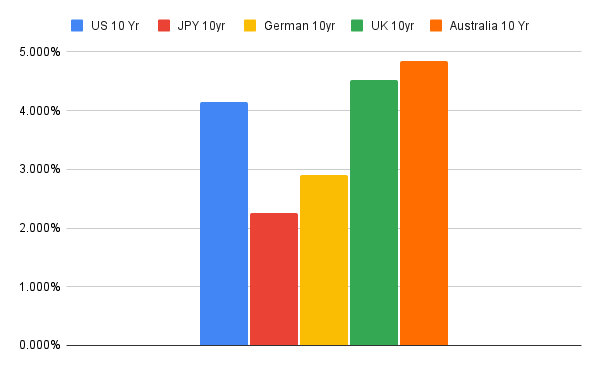
- US 10Y: 3.75%
- Japan 10Y: 2.257%
- Germany 10Y: 2.901%
- UK 10Y: 4.525%
- Australia 10Y: 4.844%
Macro interpretation:
Japan remains the focal point. When Japan’s yields climb, the global carry framework becomes more fragile because the traditional low-yield funding anchor (JPY) starts to change.
Equities (Equities vs Gold Ratios)
- S&P 500 vs Gold: 1.39
- DAX vs Gold: 5.91
- CAC 40 vs Gold: 1.93
- FTSE 100 vs Gold: 2.78
- Nikkei 225 vs Gold: 0.069
Volatility
- VIX: 16.09
Commodities
- Gold/Oil Ratio: 77.58
What this mix is saying:
- Volatility is not elevated, which supports the risk-on baseline.
- Gold remains strong, which signals ongoing hedging demand or structural support rather than pure fear.
- When signals diverge like this, the edge usually comes from selectivity, sizing discipline, and event-risk awareness, not maximum exposure.
Related reading (for deeper context):
The Gold-to-Oil Ratio: A Historical and Practical Guide (on TakezoTrading.com)
Central Bank Scoreboard
Bank of Japan (JPY)
- Policy rate: The BOJ maintained its guideline to keep the uncollateralized overnight call rate around 0.75%.
- Vote: 8–1 majority.
- Dissent: Takata dissented, arguing the price stability target was “more or less achieved” and inflation risks were skewed to the upside; he proposed moving closer to ~1.0%.
Immediate takeaway:
The BOJ held at 0.75%, but the dissent matters because it keeps a hawkish tail risk in the distribution—especially if yields continue to push higher.
FX implication:
JPY weakness can persist in stable risk-on, but if markets begin to fear a policy shift (or a carry unwind), JPY can strengthen fast. This is the key risk to respect if you’re long high beta against JPY.
Data Calendar & Event Risk (The Watch List)
High impact
| Event | Date | Base expectation | FX reaction function (what would move markets) |
|---|---|---|---|
| BoC Monetary Policy Report | Wed 28 Jan 2026 | Hold 2.25% | Hawkish / hike → CAD bullish. Cut / dovish → CAD bearish. |
| FOMC Rate Decision | Wed 28 Jan 2026 | Hold 3.75% | Hike / hawkish signal → USD bullish. Cut / dovish signal → USD bearish. |
| US Unemployment Claims | Thu 29 Jan 2026 | 202k | Above 202k → USD bearish bias. Below 202k → USD bullish bias. |
How I’ll frame the week: Wednesday is the pivot. If the Fed/BoC deliver surprises, it can override the directional list in the short term—especially in USD and CAD pairs.
COT: https://takezotrading.com/commitment-of-traders-update-jan-24th-2025/
Conclusion (Actionable wrap-up)
Weekly Playbook
- Primary macro driver to watch: Japan’s yield pressure and whether it starts to spill into broader carry de-risking.
- Best expression in FX: The cleanest broad signal is AUD strength (AUD-led longs remain the best “macro-consistent” expression).
- What would flip the view: A volatility spike, a sharp equity drawdown, or a clear signal that the carry trade is unwinding (JPY strengthening aggressively across the board).
- Key event risk days: Wed (BoC + Fed) and Thu (US claims).
- Risk management note: Stay smaller into Wednesday, avoid over-stacking correlated positions, and be ready to reduce exposure quickly if JPY starts strengthening broadly.
In Closing
If risk-on holds and Japan yield pressure stays orderly, favor AUD-led longs (especially across the watchlist); if carry unwind accelerates, reduce JPY exposure quickly and rotate toward defense.