

Method
This analysis measures each of the eight major currencies — EUR, GBP, AUD, NZD, USD, CAD, CHF, and JPY — against a single common benchmark: gold. By comparing how each currency has performed relative to gold across four timeframes (the current month, three months, six months, and one year), we can rank relative strength and derive directional signals for all 28 major crosses.
No fundamentals, no news flow, no rate expectations. This is purely relative strength. A pair earns High Conviction status only when all four timeframes agree on direction. If three of four agree, it goes on the Watchlist, with the dissenting timeframe noted. A 2-2 split means no edge, and the pair is excluded. All pairs are quoted in standard FX convention.
This Week’s Picture
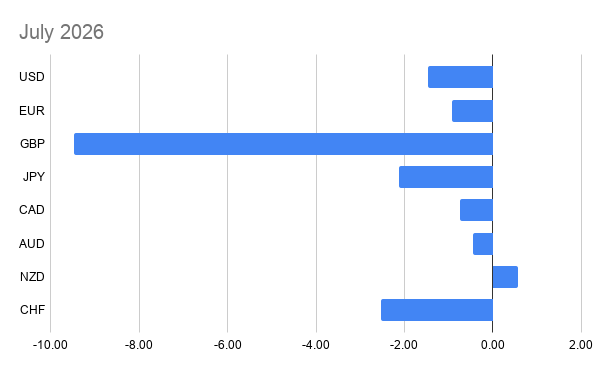
July has been gold’s month. Of the eight majors, only the New Zealand dollar managed to hold its ground against the metal this month — every other currency lost value to gold, from the euro’s modest slip to an outright rout in sterling. When gold sweeps the board like this, the monthly chart stops being about which currencies are strong and becomes about which are merely less weak. That’s exactly why we trade the relative rankings rather than the raw direction.
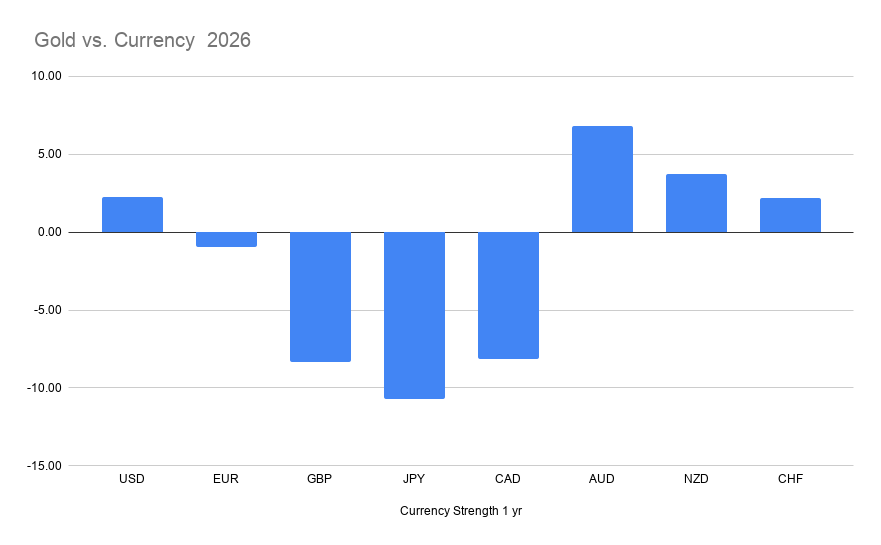
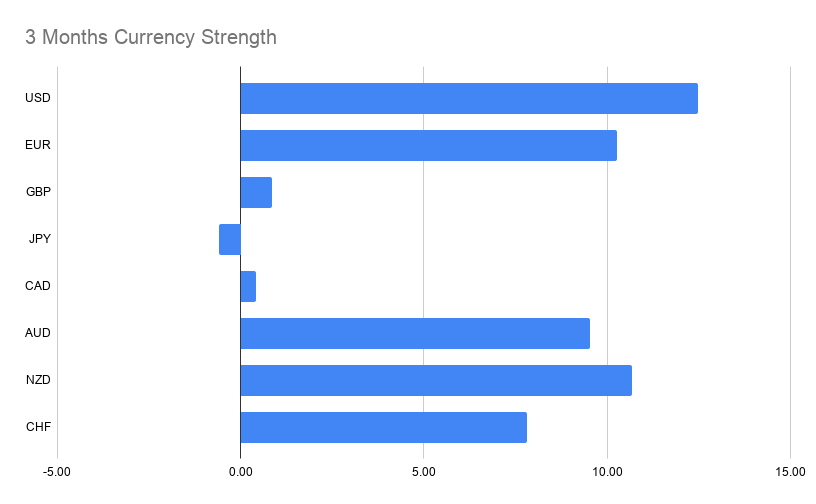
And the rankings tell a brutal story about the pound. GBP fell nearly ten points against gold in July alone — roughly four times the damage taken by the next-worst performer. It sits dead last on the monthly chart, second-to-last on the yearly, and near the bottom everywhere in between. The result is a clean sweep of high-conviction shorts: sterling is confirmed weaker than the Aussie, the Kiwi, the dollar, and the franc across all four timeframes, and weaker than the euro on all four as well. Five of our fourteen high-conviction signals this week involve selling the pound.
At the other end, the antipodeans continue to own the top of the leaderboard. AUD leads the one-year ranking outright and NZD leads July, and between them they generate five high-conviction longs — all against the usual victims: CAD, CHF, and JPY. The yen, as ever, anchors the bottom of the long-term charts, down more than ten points against gold on the year, and it remains the funding leg of choice: every yen cross except CHF/JPY confirms as a high-conviction or full-agreement long against it.
The euro deserves a word, because at first glance its signals look contradictory: long against sterling and yen, but short against the Kiwi, and on the watchlist as a short against the Aussie and the dollar. There’s no contradiction — this is what mid-pack looks like. The euro is comfortably stronger than the wreckage below it (GBP, JPY) and consistently weaker than the leaders above it (NZD, AUD, USD on the longer frames). Relative strength is a ladder, and the euro is standing on the middle rung.
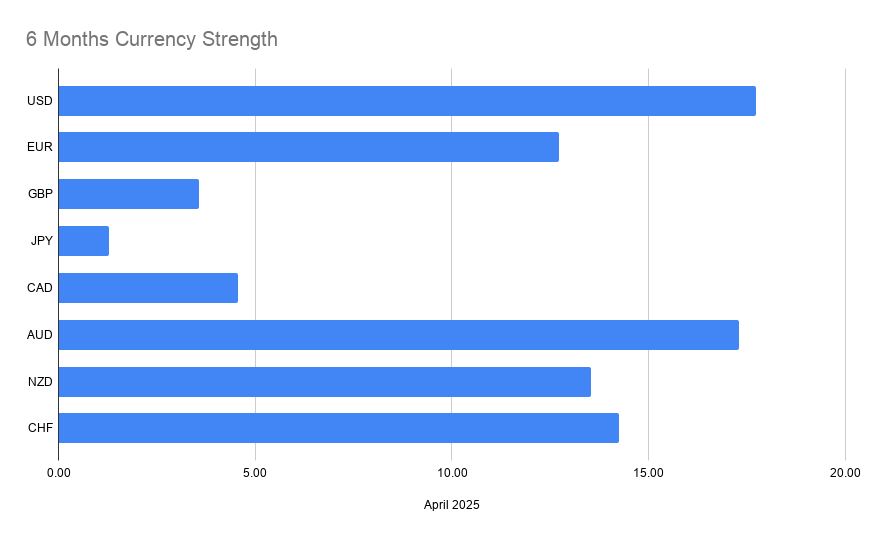
The franc tells a similar two-sided story with a twist: CHF has been genuinely strong over six months — third-best on that chart — but it had a poor July, sliding two and a half points against gold. That monthly stumble is what keeps several franc crosses off the high-conviction list and explains why CHF/JPY, USD/CHF, and CAD/CHF all sit on the watchlist with the short-term frames dissenting against the longer-term trend.
One housekeeping note on the source charts: the six-month chart is still carrying an “April 2025” axis label from an earlier template. The data itself is current; the label is not.
High-Conviction Signals
All four timeframes in agreement:
- Long EUR/GBP
- Short EUR/NZD
- Long EUR/JPY
- Short GBP/AUD
- Short GBP/NZD
- Short GBP/USD
- Short GBP/CHF
- Long AUD/CAD
- Long AUD/CHF
- Long AUD/JPY
- Long NZD/CAD
- Long NZD/JPY
- Long USD/JPY
- Long CAD/JPY
Watchlist
Three of four timeframes in agreement; the dissenting timeframe is noted beside each pair:
- Short EUR/AUD — 3-Month dissents
- Short EUR/USD — Monthly dissents
- Long EUR/CAD — Monthly dissents
- Short GBP/CAD — 3-Month dissents
- Long GBP/JPY — Monthly dissents
- Long NZD/CHF — 6-Month dissents
- Long USD/CAD — Monthly dissents
- Long USD/CHF — 1-Year is a dead heat
- Short CAD/CHF — Monthly dissents
- Long CHF/JPY — Monthly dissents
What Didn’t Make the Cut
Four pairs split 2-2 across the timeframes and offer no edge this week:
- EUR/CHF — the euro leads on the short-term frames, the franc on the long-term ones. Two mid-pack currencies trading places.
- AUD/NZD — the Kiwi has the recent momentum, the Aussie has the longer trend. The antipodean rivalry remains unresolved.
- AUD/USD — strength at both ends of the calendar for the Aussie, but the dollar owns the middle timeframes.
- NZD/USD — the mirror image of the same fight: NZD wins the month and the year, USD wins the three- and six-month frames.
Notice the pattern: all four exclusions involve the three strongest currencies on the board — AUD, NZD, and USD — plus the franc. When the leaders fight each other, there’s rarely an edge. The edge lives in pairing leaders against laggards, which is exactly what the high-conviction list does.