Hello traders and strategic market followers! Welcome back to my ongoing monthly series, where I analyze major global currencies by benchmarking their strength against gold. Gold, being stable and consistent, helps provide clarity on how each currency is performing relative to others, free from the noise of broader market conditions.
Let’s dive into the detailed performance for May 2025 and uncover what the charts reveal about the currency landscape.
1-Month Snapshot (May 2025)
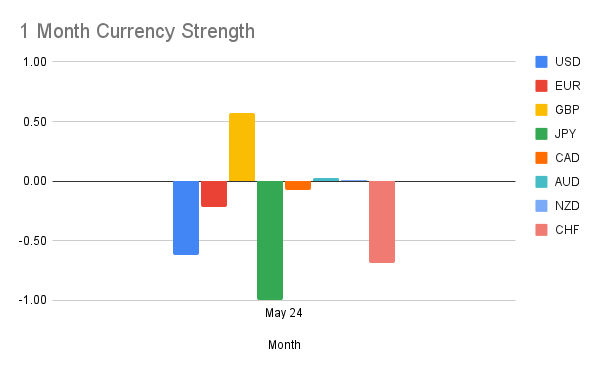
In May, we saw notable shifts among several currencies:
- British Pound (GBP), Australian Dollar (AUD), and New Zealand Dollar (NZD) all gained ground against gold. The strengthening of these currencies suggests improving market confidence or economic data in their respective regions.
- On the other end of the spectrum, the Japanese Yen (JPY) was the weakest currency for May, experiencing the most significant decline against gold. This weakness could be driven by various factors, including economic uncertainty or investor shifts away from safe-haven currencies.
Overall, the performance rankings for May 2025 are:
- GBP, AUD, NZD (strongest performers)
- EUR and CAD (neutral to slightly weaker performance)
- USD and CHF (modestly weaker)
- JPY (weakest)
Three-Month Overview (March–May 2025)
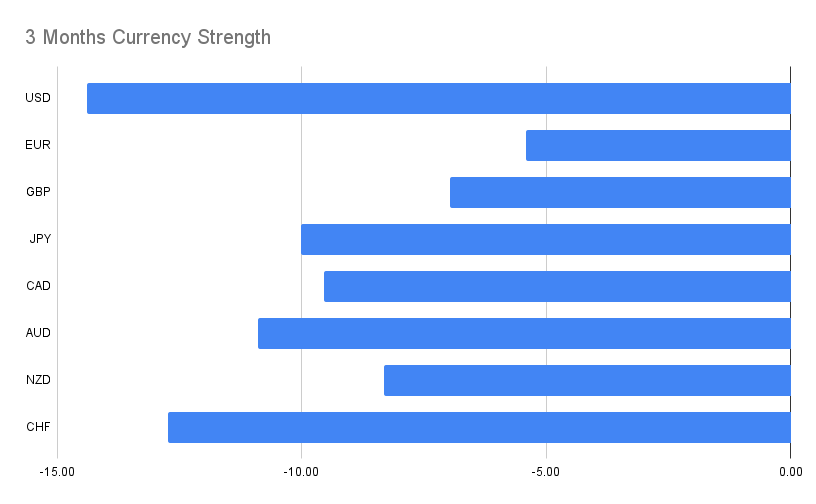
Broadening the lens to the past three months, the data clearly outlines sustained trends:
- The US Dollar (USD) emerges distinctly as the weakest currency during this period, highlighting persistent issues, possibly related to Geopolitics created by “Tariffs”, inflation concerns, or policy uncertainties.
- The Swiss Franc (CHF) also showed significant weakness, contrary to its one-month neutral performance, suggesting volatility and fluctuating investor sentiment towards Switzerland.
- The Euro (EUR) stood out as the strongest currency over this three-month window, maintaining remarkable resilience and indicating sustained investor confidence or effective economic management within the Eurozone.
Six-Month Perspective (December 2024–May 2025)
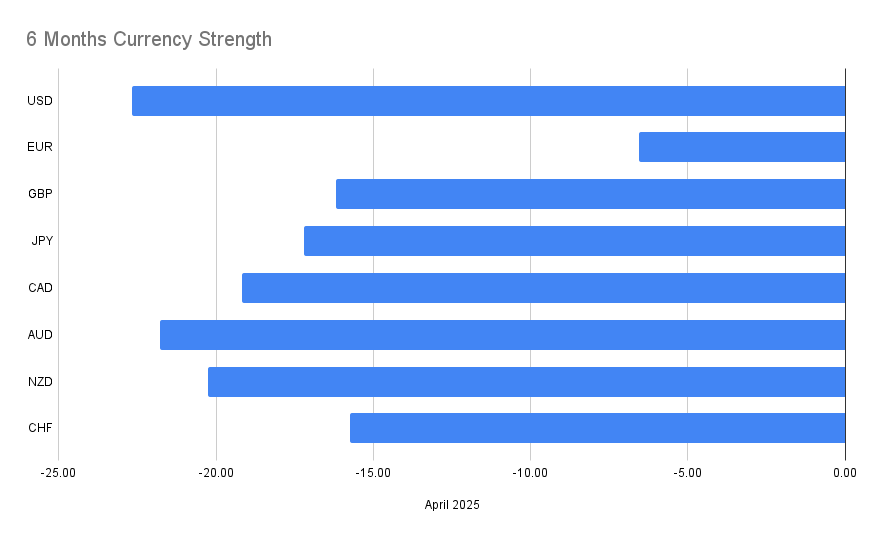
The six-month analysis further solidifies certain long-term trends:
- The USD continues its pronounced weakness, consistently underperforming all other major currencies. The persistent decline indicates deeper, structural issues.
- The Australian Dollar (AUD) also remains weak over this extended period, reflecting sustained pressure, possibly linked to commodity market fluctuations or domestic economic challenges.
- Euro (EUR) once again shows the greatest strength over six months, underscoring robust market confidence and steady economic performance within Europe.
Six-month currency rankings from strongest to weakest:
- EUR (strongest)
- GBP, NZD, CAD, CHF (moderately weaker)
- AUD (notably weaker)
- USD (weakest)
Key Observations and Insights
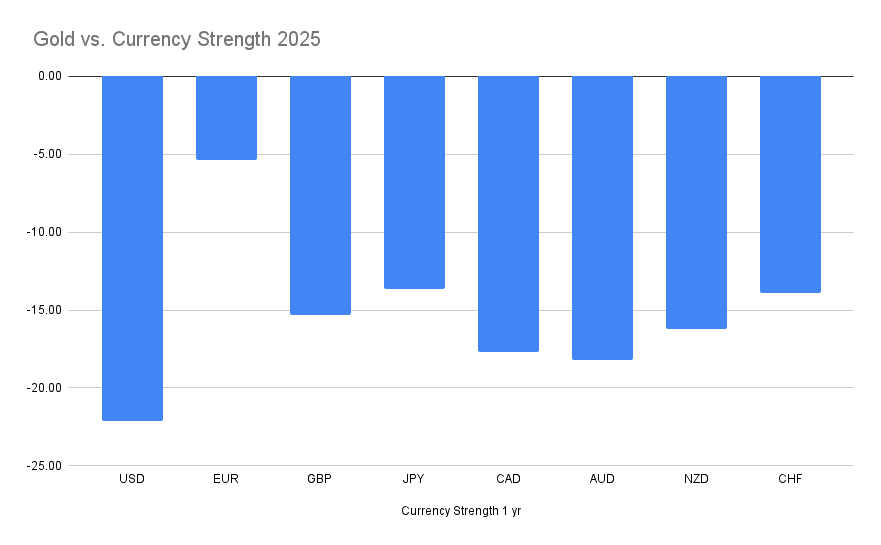
This month’s data clearly underscores certain persistent trends: continued weakness in USD and AUD, resilience in EUR, and significant fluctuations in CHF and JPY. By regularly tracking these shifts, traders and investors can remain strategically positioned and aware of underlying market trends.
For those looking to explore further details or gain ongoing access to comprehensive raw data sets, you can purchase the full data or subscribe to my website for monthly updates and free access to these valuable insights. Find more information here: Takezo Trading Raw Data Subscription.
Until next month, keep informed, trade smart, and stay strategic.
– Takezo Trading